
Modi's visit to some developed countries such as the US, Japan, China and Australia were sprinkled with humongous investment figures. But do we have the wherewithal to absorb such big investments?
'India had nothing to gain by the talks except for some brownie points from the US for being reasonable. Pakistan desperately needed the talks to get arms and money from the Americans,' says T P Sreenivasan.

'New Delhi showed itself willing -- at least for a period -- to tolerate the risk of conflict and to withstand Beijing's implicit and explicit threats.' 'But it also continued to try to cut some kind of deal with China to reduce tensions.'

Prime Minister Narendra Modi's Nepal visit was an eye-opener for most Indians, as it appears as though the hard feelings of 17 years of neglect by Indian PMs has been overcome by this single, sincere visit, says Rajeev Srinivasan.

India wants more business and closer engagement with ASEAN even as China's influence spreads in the region. Rediff.com's Sheela Bhatt, who is travelling with the prime minister on his visit to Brunei, reports from Bandar Seri Begawan, capital of the tiny oil-rich country.
All Indian prime ministers must know that the route to their Nobel Peace Prize doesn't go through Pakistan, says Rajeev Sharma.

Not many people in Bangladesh are talking about the Teesta issue.

Because of the treaty, no big dams or power projects can be built by India on Jhelum, Indus or Chenab.

'What Trump and Kim have demonstrated is that leaders need not remain prisoners of the status quo and they can, by showing the necessary will and courage, break out of the hang-ups and constrictions of the past and carve out a new pathway for themselves,' says B S Raghavan.
With an unexpected new turn in Kashmir, an ominous Afghanistan, a reliably unpredictable Trump, and an unfathomable reversal with RCEP, Modi may have to reinvent his character, suggests Ambassador B S Prakash.
'If his three priorities are the economy, the economy, the economy, then there is need for a stable region, a stable neighbourhood.'

The bonhomie between Prime Minister Narendra Modi and Pakistan Prime Minister Nawaz Sharif seems to have also finally met its demise. Here's a look at their 'relationship'.
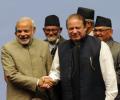
'Modi has said he has been made the PM of India not to do small things but big things. What bigger thing can there be than to have peace with Pakistan and in the neighbourhood?'

'The success or otherwise of Modi's foreign policy will largely depend on the equation he is likely to strike with Donald Trump.'
Composite dialogue likely to be formally revived; PM visit might also be marked with grant of trade MFN status. Nayanima Basu reports

'Modi's promise of change during the election campaign was on the domestic front, but his first year in office focused on foreign policy beyond all expectations,' says Ambassador T P Sreenivasan.
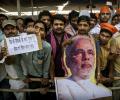
'Modi's victory is his own victory. Now what he has done thereafter, it seems to me, leads us to believe that he was a bit too prolific with his promises.' 'One achievement of Modi's I will praise is that he has put the fear of God among his ministers and officials.' 'Indira Gandhi's sentiment of controlling everything, centralising power in to her hands is the quality that persists in Modi' Veteran journalist Inder Malhotra casts his experienced gaze on one year of the Modi Sarkar.

'It seems that the BJP in its desire to catapult Modi onto the international stage, knowing the image deficit due to visa denials, has caused unhappiness in Tamil Nadu, uncertainty in Bangladesh and a churning in Pakistan that Sharif may or may not be able to control,' says Ambassador K C Singh.

Rajapaksa has blamed India, the United States and European countries for his humiliating defeat.
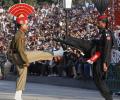
'Pakistan's capacity to carry a normal relationship with India doesn't exist.' 'The relationship with Pakistan is less important than several others.'

While India is pushed to keep a tight lid on its own carbon emissions, slow and low emission reduction by major polluters will cause an acceleration of climate change, says Rajni Bakshi.
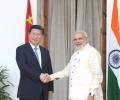
With the continuing stand-off in Ladakh casting a shadow over the Sino-India talks, Prime Minister Narendra Modi on Thursday raised 'serious concerns' over the repeated incidents along the border and sought an early settlement of the boundary question.

'Checkmating India by its nukes, Pakistan can pursue terrorism against India in the Kashmir Valley and also resume launching Mumbai 2008 style attacks.' 'The military oligarchy in Pakistan has a totally different view of what is desirable and possible in the subcontinent.'

'The Modi regime, after experimenting with its own versions of neighbourhood policy for 18 months, has now reached the exact stage where the Manmohan Singh government had left it in so far as our Pakistan policy is concerned,' says former senior RA&W officer Vappala Balachandran.

Despite criticism of a lack of transparency and communication from the Modi-led government, BJP leaders point to "good beginnings" on several fronts to defend its performance. Sheela Bhatt/Rediff.com reports.

'While military acts such as the Uri surgical strikes are one option, cultural, economic and diplomatic isolation should also be part of the arsenal,' argues Sankrant Sanu.

'To identify with the common man, Modi had to look like one.' 'The disastrous suit with his name written on it never made its reappearance.' 'Frequent dress changes during the day, which led Arvind Kejriwal to calculate that Modi spent crores on his attire ever year, too stopped.' 'Instead, a newer Modi emerged: Humble and eager to serve.' Narendra Modi has cleverly repositioned himself as a man of the masses in the past three years, says Aditi Phadnis.

Silicon Valley can be replicated, but this will only be achieved so long as fresh talent is welcomed by both our countries - a move that will surely spark a billion ideas and discoveries.

'Xi Jinping got a dose of Modi's medicine inside the tent where he was being hosted on the banks of the Sabarmati river.' 'Modi reportedly told him, looking deep into his eyes: "This was not expected of your country. Can you tell me when the troops are withdrawing?".'

To persist with talks in the face of continuing terrorism that puts hundreds of Indian lives at stake is not only naive but morally repugnant and ethically unacceptable. It is time to see through this charade and abandon a path of high risk and no returns, says Vivek Gumaste.

'Pakistan's military leaders have to accept that the policy of proxy wars has damaged Pakistan more than it has damaged the enemy,' says former R&AW chief Vikram Sood.

'I like to see myself as a troll-slayer and I have realised the best way to do that is to ignore them. Nothing bothers them more,' Barkha Dutt tells Rashme Sehgal.

'The Modi government's pusillanimity vis-a-vis Pakistan makes almost certain that India will, in the coming weeks and months, be confronted with cross border terrorist actions of increasing intensity,' warns Satish Chandra, former deputy national security adviser.

Once again an Indian prime minister has realised that with Pakistan and China, things will not move as he wishes.

'Tibet remains a prickly issue between the giant Asian nations. China still claims more than 80,000 sq kilometres of Indian territory in the Northeast. Why? Just because Beijing refuses to acknowledge the McMahon line which separates India and Tibet, and this, simply because the 1914 Agreement delineating the border was signed by the then government of independent Tibet with India's then foreign secretary (Sir Henry McMahon),' says Claude Arpi.
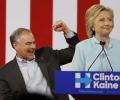
Rediff.com reproduces this 2014 interview with Tim Kaine where in he discusses the new opportunities to foster Indo-US trade and the improvement in ties.

The Security Council as it is today is unable to bring peace and security in the world and so there is reason for countries like India to become members of the Council, Ambassador Asoke Kumar Mukerji tells Sheela Bhatt/Rediff.com.
